
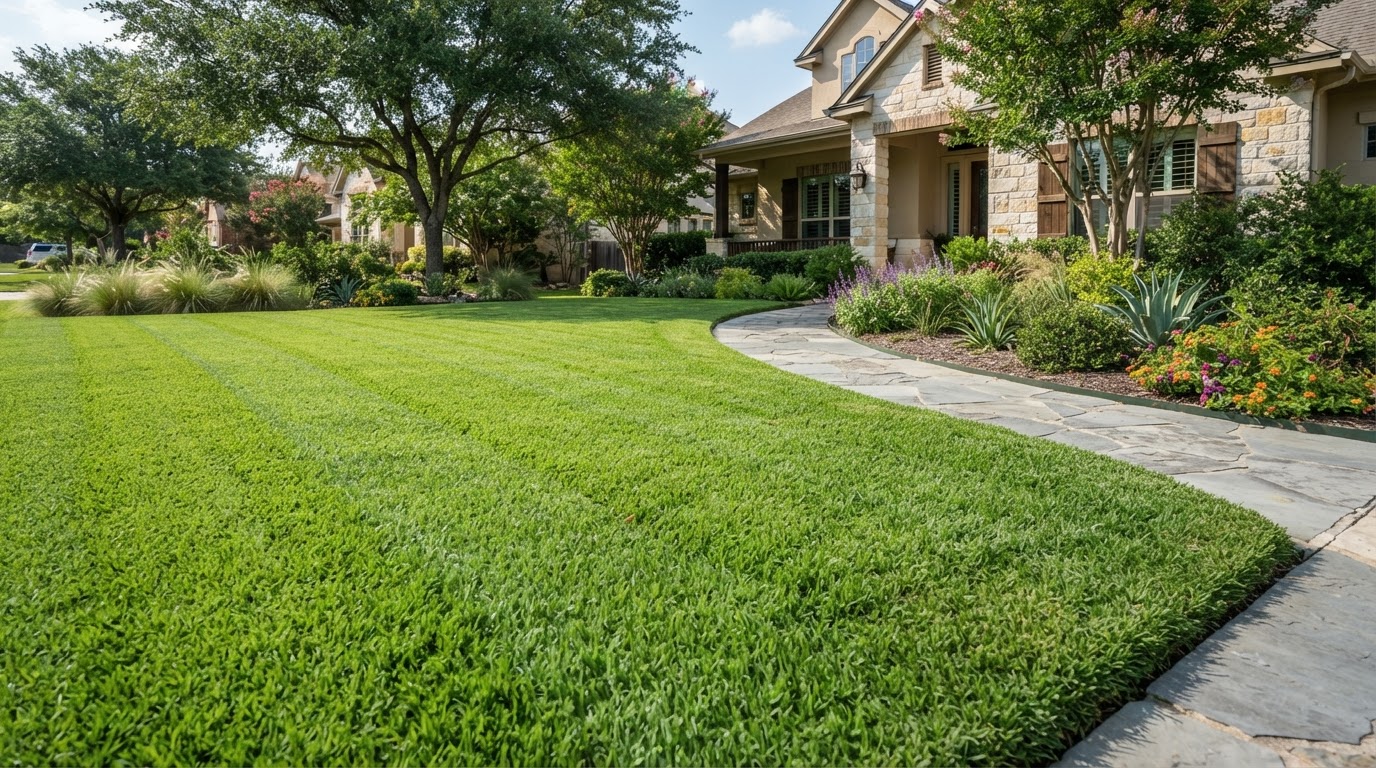
How Often to Mow St. Augustine Grass Spring
St. Augustinegrass is mowed by growth, not by the calendar. Mowing frequency depends primarily on actual grass growth, the intended mowing height, the weather, the irrigation, the light, and the lawn's condition — so a fixed weekly interval does not suit every property year-round. Texas A&M AgriLife Extension's one-third mowing principle — never removing more than about a third of the leaf blade at a cut — is the practical rule, and Heritage helps Spring homeowners keep St. Augustine lawns mowed at the right height and frequency for the real conditions.
Choosing the Right St. Augustine Mowing Height Near Spring
The right mowing height follows the cultivar, the growth rate, the shade exposure, the mower configuration, and the turf's stress level. Texas A&M AgriLife Extension's St. Augustinegrass guidance discusses a general mowing-height range of roughly 2–4 inches, with cultivar and site considerations — a shaded lawn is generally mowed a little higher than a full-sun lawn so the taller leaves can capture the limited light. The exact suitable height is selected for the actual lawn rather than a single number applied to every property, and a sharp blade keeps the cut clean so the grass is not torn.
The one-third guideline
The one-third guideline says to never remove more than about a third of the leaf blade at a single cut. Following it helps avoid stressing the turf, encourages deeper rooting, and keeps the lawn from being scalped — but it is a practical rule, not a guarantee against lawn stress. When growth outpaces the mowing schedule, the frequency increases so each cut stays within the guideline rather than removing too much at once.
How St. Augustine Mowing Changes Through the Year in Spring
St. Augustinegrass is a warm-season grass, so its growth rises and falls with the season. During active warm-season growth with rainfall and warmth, a lawn may need mowing roughly weekly; during summer heat and moisture stress, growth can slow; and during cooler periods and winter dormancy, mowing drops off or stops. The frequency follows the actual growth rather than a fixed date — and mowing by date regardless of conditions is not the right approach. Note the distinction between Spring, Texas, the city, and the spring growing season: both matter, but the mowing follows the grass, not the calendar.
Mowing is delayed after saturated conditions. Running heavy equipment over wet, saturated turf can compact the soil and tear the grass, so the schedule waits for the ground to drain and firm up rather than mowing on a fixed day regardless of conditions. Heavy rainfall can also push rapid, uneven growth, so the frequency adjusts to the actual growth rather than the calendar.
Preventing St. Augustine Lawn Stress Near Spring
Most St. Augustine stress from mowing comes from a few recurring mistakes — cutting too low, removing too much leaf tissue at once, mowing with a dull blade, running heavy equipment over saturated turf, inconsistent mowing during rapid growth, and misreading brown or sparse areas as a sign the lawn simply needs more mowing. Lawn discoloration can also arise from insects, disease, irrigation, compaction, shade, nutrient conditions, or other causes, so it is not diagnosed from appearance alone. The right mowing practice follows the grass's actual condition rather than a routine that ignores what the lawn is telling you.
Clippings, airflow, shade, and mowing limitations all interact. Grasscycling returns nutrients when the clippings are small and filter into the canopy, but heavy clumps should be dispersed; a shaded lawn needs a higher cut and less traffic than a sunny one; and a thinning or discolored lawn is evaluated for its real cause — insects, disease, irrigation, compaction, shade, or nutrients — rather than assumed to be a mowing problem.
St. Augustine Mowing Questions in Spring
St. Augustine Lawn Maintenance in Spring
Mowing frequency connects to the rest of the maintenance plan — edge care, irrigation assessment, seasonal adjustments, and the right height for the actual conditions. Tell us about your lawn — the property address, the grass type, the current condition, and a photo taken safely from the ground — and we review each inquiry by the actual site before discussing a mowing schedule or a fuller lawn maintenance plan.
Primary Sources
Request an Estimate
Required: name, contact details, project address, desired timeline, and a photo you can take safely from the ground.