
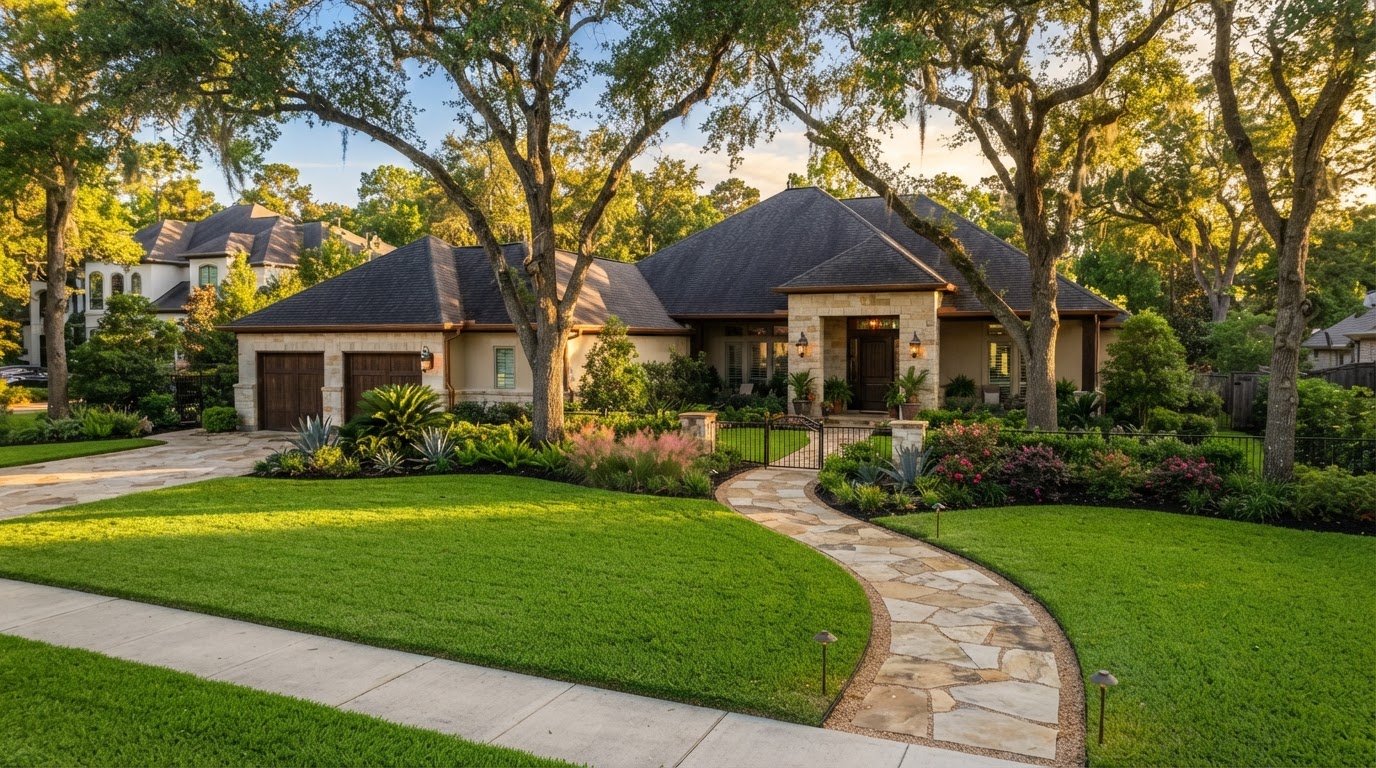
Shade-Tolerant Lawn Solutions Spring
A thinning, patchy lawn in a shaded yard is rarely just a grass problem. Sunlight, competing tree roots, soil moisture, drainage, and mowing practices all shape whether turf can hold up — and no single grass variety overcomes all of them. The right solution may be a more shade-tolerant grass, a partial repair, corrected irrigation, or converting the worst areas to beds or groundcover. The choice follows the actual conditions the lawn is growing in, not an automatic recommendation to replace the whole yard.
Choosing Grass for Partial Shade Near Spring
Among the warm-season grasses grown in Southeast Texas, some tolerate reduced light better than others — but none thrive in deep shade. The comparison below covers the main options and the conditions that shape which one, if any, fits your yard.
St. Augustinegrass Varieties
Among warm-season grasses grown here, certain St. Augustine varieties tolerate filtered and partial shade better than most, holding turf where Bermudagrass would thin out. The right cultivar depends on how much direct sun the area actually receives and how the lawn is used — not every St. Augustine variety handles shade equally.
Zoysiagrass Varieties
Some zoysiagrass varieties handle light to moderate shade and moderate foot traffic well, offering a dense, slower-growing alternative where shade and use combine. Whether zoysia is the right fit follows the actual light, root competition, and soil moisture the area receives.
Bermudagrass Sunlight Limits
Bermudagrass needs full sun and thins quickly in shade, so it's rarely the right choice beneath trees or along shaded fence lines. Where the area gets full sun all day it performs well; where it doesn't, a more shade-tolerant grass or a non-turf option usually makes more sense.
When Grass May Not Be the Best Option in Spring
In some shaded areas, no grass is the right answer — and repeatedly replacing sod without fixing the cause just repeats the failure. When the conditions below apply, alternatives usually hold up better than turf.
Alternatives can include landscape beds, mulch, suitable groundcovers, stepping-stone paths, and limited artificial turf where appropriate. No one grass performs best in every shaded yard — the recommendation follows the actual conditions.
Evaluating a Shaded Lawn Near Spring
A shaded lawn is reviewed before any repair or replacement is recommended, so the solution addresses what's actually limiting the grass rather than assuming new sod will fix it.
Sometimes correcting the conditions — irrigation, drainage, compaction, or canopy — does more for a shaded lawn than new sod. Buying new grass for an area the site won't support usually means replacing it again. The evaluation sorts out whether the lawn needs repair, replacement, or a different approach altogether.
Improving Lawn Coverage in Shaded Spring Yards
Where repair or replacement is the right path, the work addresses the cause along with the turf so the new grass has a chance to establish — and the worst areas may be better converted to beds than re-sodded.
What Shapes a Shade Lawn Estimate
- Area size
- Existing turf removal
- Soil conditions
- Sod selection
- Site access
- Irrigation adjustments
- Number of affected zones
Shade-Tolerant Lawn Solutions Questions in Spring
Find the Right Solution for Your Shaded Lawn Near Spring
Tell us about the shaded area — how much sun it actually gets, what's growing overhead, and what the turf is doing — along with a few photos taken safely from the ground. We review each inquiry by location and conditions before discussing an appropriate approach.
Request a Shaded Lawn Estimate
Required: name, contact details, project address, desired timeline, and a photo you can take safely from the ground.